Introducing RONDu, a cosmological model where rotation and geometry of our black-hole universe drive cosmic evolution and the quantum realm.
GET THE FULL PAPEROur research develops RONDu (ROtational Newtonian Dynamics - Universal), a framework where we test how rotation, curvature, and spacetime stretch shapes galaxy dynamics, voids, clusters, filaments, dark matter, dark energy, and quantum mechanics.
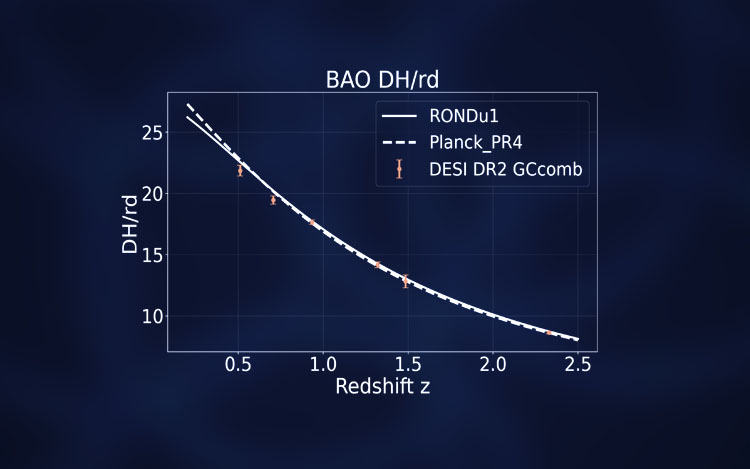
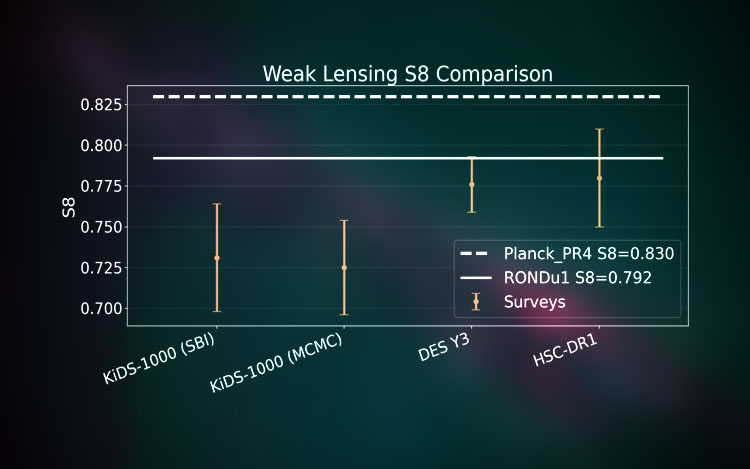
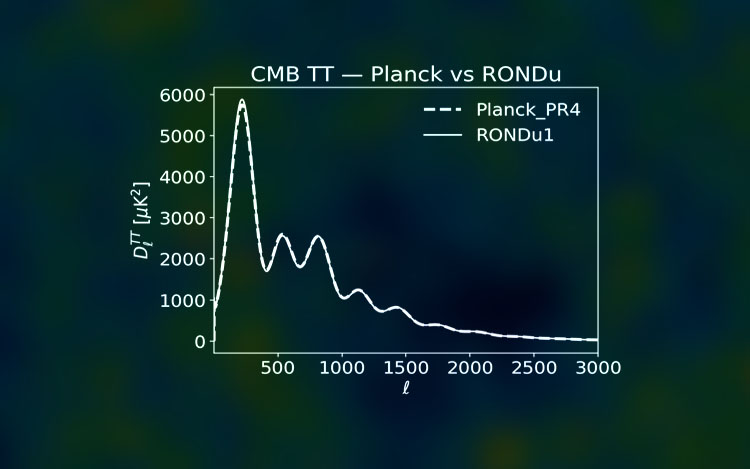
Our work combines analytical modeling, AI-based simulations, and observational comparisons with BAO structure, CMB measurements, and cosmic flow data. We focus on testing RONDu’s cosmic and quantum predictions, and building open tools for independent verification.
RONDu cosmology proposes that our universe formed through the cold self-collapse of a gravity field into a spinning black-hole structure. Only ordinary baryonic matter and radiation exist; there is no dark sector. What we call dark matter arises as a gravitational anomaly created by rotation-drag and the cumulative stretching of spacetime inside the gravity field. Dark energy is simply the inward collapse-force of the gravity bubble — the black-hole universe itself. Inflation and big-bang are not required.
Inside this structure, time and space exchange roles: time behaves like a spatial dimension, and space behaves like time. This reversal explains the long-standing confusion about the universe’s “age.” The commonly cited 13.8 billion years is, in the RONDu interpretation, the current radius of the black-hole universe — 13.8 billion light-years.
We provide a clear, structured pathway for readers to explore the foundations of RONDu: from large-scale structure and rotation-driven dynamics to the geometric mechanisms governing cosmic evolution. Dive into the concepts, derivations, and observational alignments that shape this new perspective on how the universe actually works.